
What are Candidate Labels? How are they used?
Candidate Labels are customizable tags that can be applied to candidate profiles to help organize, categorize, and identify candidates throughout your hiring process.
Labels are internal tools used by your hiring team and are not visible to candidates. They can be used to track information that may not fit into your standard hiring workflow, making it easier to group, search, filter, and report on candidates.
Why Use Candidate Labels?
Candidate Labels provide a flexible way to organize candidate information.
Common uses include:
- Tracking candidate availability
- Recording skills or certifications
- Identifying language proficiencies
- Grouping candidates into talent pools
- Marking candidates for future opportunities
- Categorizing candidates based on internal recruiting needs
Because labels are customizable, your team can create a structure that supports your unique recruiting process.
Examples
| Label | Purpose |
|---|---|
| Available: Fall 2026 | Indicates when a candidate may be available |
| Language: Spanish | Identifies language proficiency |
| Certification: CPA | Tracks professional certifications |
| Talent Pool: Sales | Groups candidates for future sales roles |
Adding Candidate Labels
You can apply labels directly to a candidate profile.
- Open the candidate's profile.
-
Locate the Labels section.
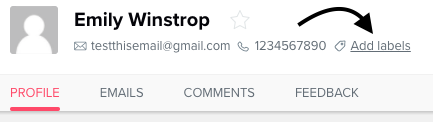
- Enter an existing label or create a new one.
- Save your changes.
Once applied, labels become part of the candidate's profile and can be used throughout the system for organization and filtering.
Adding a Label from the Candidate List
Click on "Candidates" on the left bar of your Trakstar Hire screen

Find the candidate(s) you are after, and click the check box(es) beside them
Note - you can only add labels to more than one candidate at a time if you have bulk actions enabled on your pricing plan .
Click "Add Label" below the top bar

A box displays for adding the label. You can choose any previous labels you've created or you can type in a new label you'd like to create. For a new label, you will need to either press enter after typing the label or choose to complete the new label from the dropdown that appears below the text you added:

The label will then appear as "complete" and you can click "Save" to add it to the candidate. You can add more than one label at at time as well, simply continue typing and picking labels before clicking "Save":

The label will now display on the candidate's profile. This example candidate has been labeled as a Bilingual:

Filtering Candidates by Label
Candidate Labels can be used as filters within the Candidates List.

This allows you to quickly locate candidates who share specific attributes or classifications.
For example, you can filter to view:
- Candidates with a specific skill
- Candidates in a particular talent pool
- Candidates available during a certain timeframe
- Candidates assigned a specific internal category
Labels can also be combined with other filters, such as openings, stages, or application data, to create highly targeted candidate lists.
Using Candidate Labels in Reports
Candidate Labels can be included in the Candidates Report.
Important
For labels to appear correctly in reports, they must contain a colon (:) separating the label category from the value.
Examples:
| Label | Report Output |
|---|---|
| Available: Fall 2026 | Column: Available → Value: Fall 2026 |
| Language: Spanish | Column: Language → Value: Spanish |
| Certification: CPA | Column: Certification → Value: CPA |
In reports:
- The text before the colon becomes the column header.
- The text after the colon becomes the candidate's value within that column.
Labels that do not contain a colon will not be structured into report columns in this way.
Candidate Labels vs. Opening Tags
Candidate Labels and Opening Tags serve similar organizational purposes, but they apply to different records.
| Feature | Candidate Labels | Opening Tags |
|---|---|---|
| Applied to | Candidates | Job Openings |
| Visible to candidates | No | No |
| Used for internal organization | Yes | Yes |
| Can be used for filtering | Yes | Yes |
Use Candidate Labels when organizing people and Opening Tags when organizing job openings.
Best Practices
To keep labels useful and consistent across your account:
- Establish naming conventions before creating labels.
- Use category-based labels with a colon when reporting is important.
- Avoid creating multiple labels that represent the same information.
- Regularly review labels to ensure consistency across recruiting teams.
- Use labels alongside saved candidate filters and talent pools for more efficient candidate management.